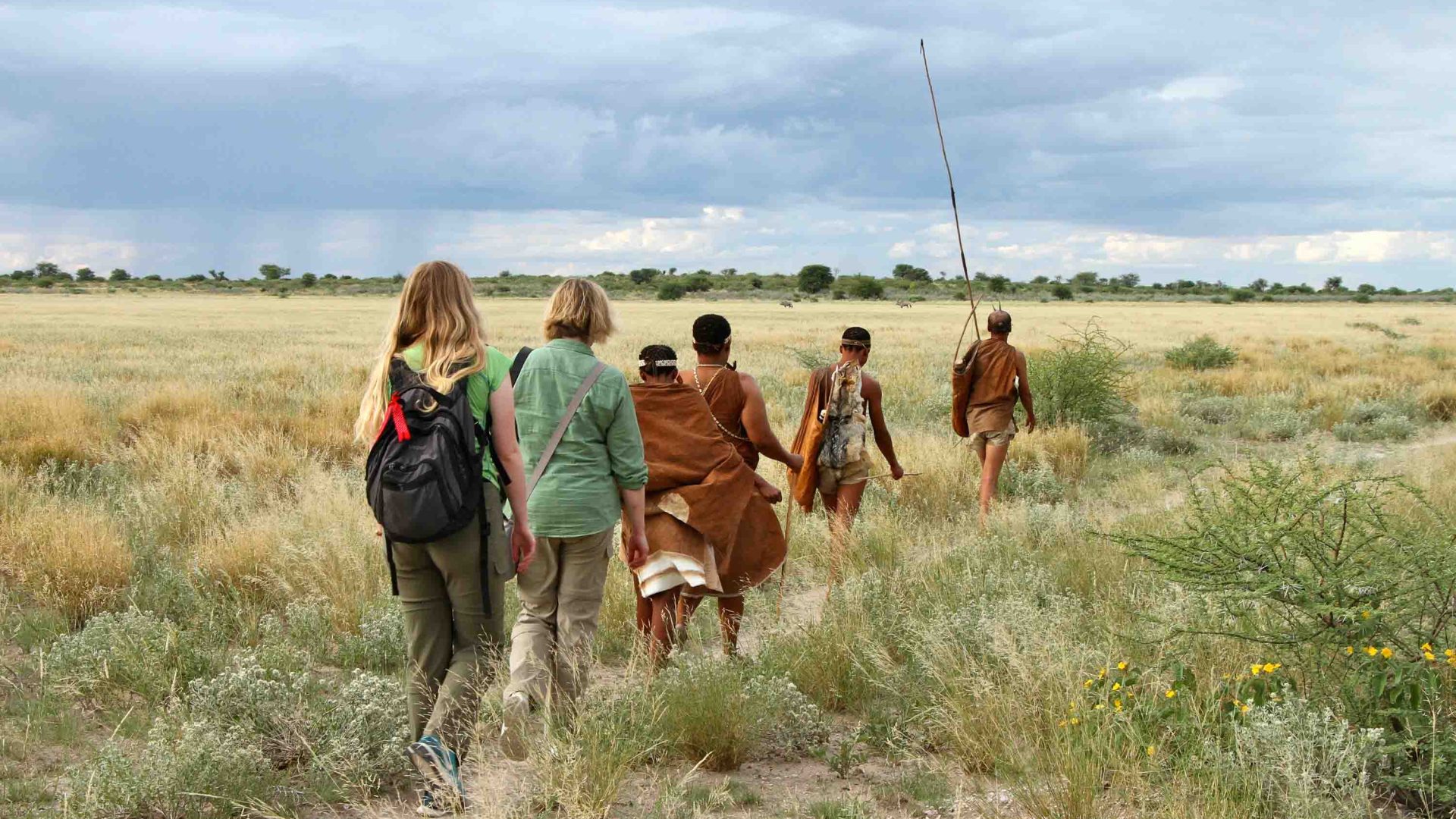
Camping on cracked earth in the middle of one of the world’s largest salt pans followed by a zebra migration across a dried-up riverbed prove to be an unexpected safari combo in this pocket of Botswana.

Camping on cracked earth in the middle of one of the world’s largest salt pans followed by a zebra migration across a dried-up riverbed prove to be an unexpected safari combo in this pocket of Botswana.
“Makgadikgadi means ‘dry and thirsty place’,” our guide Metal Matmos tells us. No kidding. This is cracked earth indeed. We’ve arrived at one of the world’s largest salt pans to spend a night under one of the planet’s darkest skies.
Bar our group and guides, there’s no-one around in this southern section of the lunar-like Makgadikgadi Salt Pans. Here, in northeastern Botswana, southeast of the Okavango Delta in the Kalahari Basin where the ancient Lake Makgadikgadi (pronounced Mah-caddy-caddy) once stood, salt denies grass and trees cannot germinate. It is barren, vast and surreal.
As we drive closer to where Metal’s colleagues are setting up trestle tables and chairs, I spot our ‘rooms’ in the distance. Five cozy ‘bedrolls’ with a thick duvet inside bivvy bags—a tent-like covering we can crawl into—a couple of storage stands, and each bedroll a sizeable distance apart.
Camping is not in my comfort zone—mostly down to an ick for shared bathrooms as opposed to sleeping outdoors, which is the good bit. But one thing travel does is test, and stretch, comfort zones. Perhaps falling asleep under a dark sky resplendent with stars on this flat, crater-like landscape with a 360-degree view of the horizon will do just that.


An equally fair distance away in the opposite direction is the ‘bathroom’, a tented toilet with a washing bowl outside. It’s clean, far enough for privacy, close enough to (mostly) avoid middle-of-the-night Salt Pan Scaries. It passes the inspection.
As Metal, full name Mathale Mosheti, gets the campfire going, I grab a moment to take in the vastness around us. I’ve traveled to remote spots before: The Kalahari Desert in South Africa’s Northern Cape province; the salt desert of Kutch, Gujarat in northwestern India; Churchill, Canada, the polar bear capital of the world. But I’d never felt this distant from life, so completely off-grid, surrounded by a silence that’s both unsettling and soothing.
Within minutes, I fall asleep. When I wake, it’s to the most exquisite sunrise, a soft orange glow rising from the flat horizon ahead.
This Makgadikgadi Salt Pans sleep-out is a seasonal experience from Desert & Delta’s Leroo La Tau lodge, one of 11 lodges and camps in their Botswana portfolio. A four-hour drive from the salt pans, I’d already spent one night there, and would return for another, if I survived the camping. 100 percent-Botswana-owned, all properties are managed by local people with staff empowerment woven in; Chobe Game Lodge, further north, is home to Botswana’s first all-female-led guiding team.
I head to where Metal and the team have set up a dining area and campfire. He hands me a bottle of local St Louis lager to accompany sunset. “What was Lake Makgadikgadi once covered an area larger than Switzerland,” he tells me. During the wet season, water surrounds the edges of the pans, attracting zebra, wildebeest and antelope en route to greener pastures, and flamingoes to the saltwater lakes that spring up.
Metal, who has worked for Desert & Delta Safaris for nearly 18 years, is also a walking encyclopedia, whether it’s geology, birdlife or conservation. He’s one of those enigmatic guides you don’t forget and I feel lucky to have met a fair few on my travels; like others, he has a natural calling to share the joy of the landscapes, people and wildlife around him.

After cold beers at sunset and a barbecued meal under the southern skies, bed beckons. The bedroll is cozy, and looking up is like being in a planetarium. I take out my phone, purely to bring up an offline stargazing app.
I find the Southern Cross and a haze of stars that form the Milky Way. It’s utterly mesmerizing. While other constellations elude me, just staring up into the night, with zero light pollution, is satisfying enough. Perhaps a cliché for a reason, but I realize that sometimes we need such moments to remember how insignificant we are, to come outside of our own heads. I doubt this late-night philosophizing lasts long and I’m sure I fall asleep within minutes. When I wake, it’s to the most exquisite sunrise, a soft orange glow rising from the flat horizon ahead.
At breakfast, we trade stories of our first salt pan camping experience. I admit, despite craving a hot shower, I leave the salt pans with a slight pang. When it’s a daily challenge to quieten the busy mind, this one night had done exactly that.
Back on the road, a movement in the grasslands catches Metal’s attention. We all squint and ‘tune in’ with our eyes; I see something vaguely stripy scampering across the savannah. Metal’s eyes glint. “It’s an aardwolf.”
It’s a rare sighting—it’s only the fourth time he’s seen one. “They’re from the same family as hyenas,” he tells us. Despite their somewhat feral carnivorous appearance, I learn they’re actually insectivores. An aardwolf’s idea of a good feast is munching around quarter of a million termites in one night, using their signature long sticky tongue to catch them.


It’s a joy to return to my room at Leroo La Tau, perched above the seasonal Boteti River, the main outflow of the Okavango Delta, and along the western boundary of Makgadikgadi Pans National Park. Its 11 thatched-roof chalets and one suite are glass-fronted, so wherever you sit, stand, lie down—or even shower—there’s a Royal Circle view of the riverbed and watering holes. The river had began to recede in the mid-1980s, due to fewer flood waters from the delta and low rainfall. By the mid-1990s, it had dried up entirely, leaving just a few waterholes for crocodiles, hippos, zebras and wildebeest. In 2009, record rainfall arrived, reinstating this watercourse, albeit with a degree of unpredictability.
Today, some 15,ooo zebras move 310 miles (510 kilometers) between the Okavango Delta/Moremi region and the Makgadikgadi Pans. We’re towards the end of the May-October dry season, the rainy season looming, and this river-turned-ravine, following a shift in tectonic plates, is teeming with herds of zebra, wildebeest, oryx, impala, elephants. Sat on the deck looking over the Boteti River Valley, I enjoy the scene unfolding in front of me. What I am sure is a vulture flies past then swoops below. Moments later, a monkey appears on the railings. I eyeball him or her, while guarding my cookie and sipping my tea.
“When you reach a herd of elephants, you should pass by when they’re behind you, so you can drive forward if you need to and not in reverse which is slower. If guests want to die, they can die somewhere else.”
- 'Metal' Mathale Mosheti, Desert & Delta Safaris guide
Later, I head to the lodge’s hide, past the campfire and pool, for a closer close-up. It’s extraordinary to see zebras, wildebeest and the gang this close, and in such numbers. Walking back to the restaurant, an impala wanders across the lawn. They pause, I pause. For urbanites like me, these moments are (almost) as enchanting as the mightier scenes below.
It’s also a reminder you are on the edge of a national park. When darkness falls, staff escort you to the rooms, and we’re advised to be vigilant. A windstorm blows outside, an eerie combination of piercing shrieks and deep gusts. Later, what we’re convinced is a leopard, comes close to camp. It’s exciting when you’re inside four walls and cocooned under a duvet and mosquito net. It’s definitely not the time to step onto the balcony to test your camera’s ‘night mode’.

No matter what ‘people’ say about the early-morning game drive, I’ve always rated the late afternoon one. The bleary eyes of the dawn safari are long gone, it’s still warm, wildlife is mooching about, and golden hour is kicking in. As we drive through Makgadikgadi Pans National Park with our ranger Kets, Metal shares some of his road safety tips.
“When you reach a herd of elephants, you should pass by when they’re behind you, so you can drive forward if you need to—and not in reverse which is slower,” he tells us. “If guests want to die, they can die somewhere else.”
It sounds perfectly logical. We bookmark this advice in our heads for the next time we’re driving and come across a herd of the largest living mammal on earth.
As we head down to the riverbed itself, the scenes from our decks are magnified. African savanna elephants on the move, dazzles of zebras sip at watering holes, a confusion of wildebeest join their stripy friends for a drink, and above, a kori bustard, the largest flying bird native to Africa. From a ridge, we spot crocodiles lurking at the water’s edge and grunting hippos enjoying their late afternoon dip.
Alongside elephant health and safety, Metal tells us why zebras and wildebeest can happily graze together; zebras like taller grass while wildebeest go for shorter grass. “And you see how the impalas have an M-shape on their back?” he asks. We nod, expecting some mystical interpretation. “We call it McDonald’s for the lions.”


We know our chances of seeing lions are slim, due to human-wildlife conflicts. “Lions used to go beyond the gate and kill goats in the villages; then they’d be killed,” says Metal. The river is the boundary, with the national park on one side, and community land and the lodge’s private land on the other.
Communities live close to and around national parks and reserves, and their livelihoods and food security is vital. It’s something Desert & Delta are acutely conscious of, and part of their work involves investing in local education, community empowerment, and research. I’m reminded of a talk I attended back in London: “When an animal destroys someone’s garden, that person doesn’t have a Waitrose at the end of their road.”
On my final morning, I stand on the deck and watch the scene in front of me for the last time. Zebras yap like puppies reuniting at Doggy Daycare, elephants arrive majestically at the watering hole, giraffes stroll along the ravine, while wildebeest, who look like they picked up the last remaining body parts in a fancy dress shop, move en masse. Between this sensory overload and the quiet emptiness of the salt flats, I feel my senses have had the full workout.
**
The writer’s trip was supported by Desert & Delta Safaris and African Pride who curate a variety of packages in their properties across Botswana including Leroo La Tau and the salt pans sleep-out (dry season/June to October).
****
Adventure.com strives to be a low-emissions travel publication. We are powered by, but editorially independent of, Intrepid Travel, the world’s largest travel B Corp, who help ensure Adventure.com maintains high standards of sustainability in our work and activities. You can visit our sustainability page or read our Contributor Impact Guidelines for more information.

London-born-and-bred with a Ugandan-Indian heritage, Meera Dattani is Adventure.com's executive editor and an award-winning freelance travel journalist. Her stories center on food and cultural heritage, wildlife and conservation, and soft adventure, often through a lens of decolonizing and modernizing travel writing. Her work has been published in National Geographic Traveller, BBC Travel, Condé Nast Traveller, Olive magazine and many others.